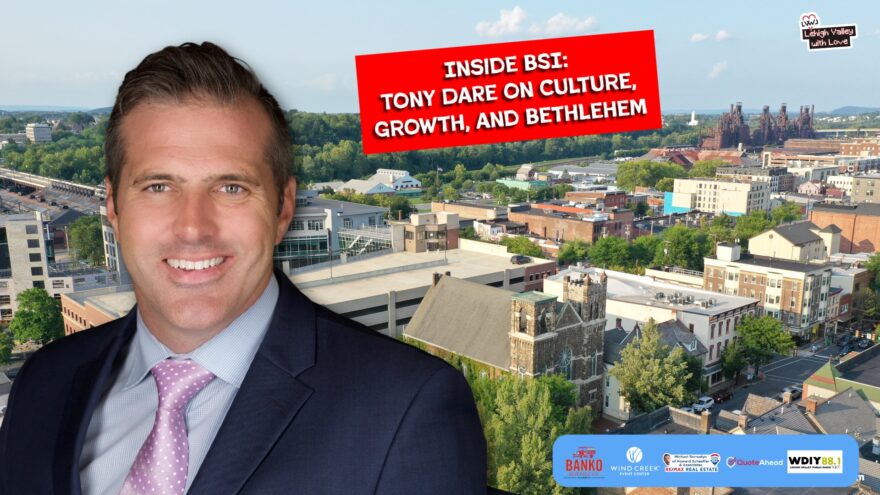
We visited Tony DaRe, founder and CEO of BSI Corporate Benefits, at the company’s headquarters inside Bethlehem’s historic Victory Firehouse.
Instead of sitting down for a traditional interview, Tony took us through the building while talking about how he built BSI, what the company does for employers and their employees, and why culture has become such an important part of the business.
Building BSI differently
Tony started working in insurance when he was 17. Eventually, he realized he wanted to be on the side representing employers, their employees and their families rather than the insurance carriers.
More than two decades later, BSI works with employers on employee benefits, healthcare and workforce strategies. Tony also talks about the way the company has grown around its people, including a workplace where employees can move throughout the building and work alongside different teams.
Culture first
“We almost entirely recruit for culture first,” Tony tells us. “We can teach deductibles and coinsurance.”
We meet a few members of the BSI team along the way and hear more about the company’s people-first approach. Tony also talks about the talent BSI has added to its leadership team and why he is bullish on what the next five, 10 and 15 years could look like.
That growth follows a busy year for BSI, including the 2026 CORE Annual Summit at SteelStacks, which brought nearly 400 business and community leaders together to discuss healthcare costs, workforce pressures, technology, culture and leadership.
Inside the Victory Firehouse
The building is as much a part of the visit as the company itself.
BSI is headquartered inside the former Bethlehem Steel firehouse near SteelStacks. Tony takes us through the workspace, upstairs to the rooftop overlooking South Bethlehem, and into areas that still carry pieces of the building’s history.
One of the most personal connections is a mural based on an old photograph of Tony’s great-grandfather working with steel. Tony’s great-grandfather immigrated from Italy in 1911, and his great-grandfather and grandfather spent a combined 80 years working in the steel industry.
Tony built BSI after deciding he wanted to do things differently in an industry he had been part of since he was a teenager. Today, that company is growing inside a former Bethlehem Steel firehouse with its own connection to his family’s history in the Lehigh Valley.
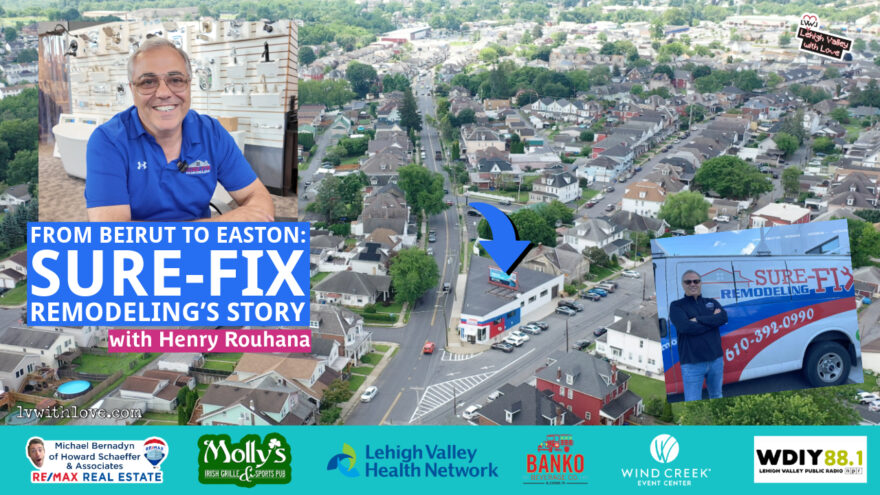
In this episode of the Lehigh Valley with Love Podcast, we talk with Henry Rouhana, founder of Sure Fix Remodeling in Easton, Pennsylvania.
Henry’s story begins in Lebanon, where he spent summers on construction sites and found inspiration watching architects bring spaces to life. After earning his architecture degree from ALBA in Beirut, Henry immigrated to the United States with his wife and two young children.
Starting over was not easy. With no money and no resources beyond his determination, Henry launched Sure Fix Remodeling. Over time, his business grew to include a full showroom and a trusted team of family members.
Today, Sure Fix is known for its commitment to design, craftsmanship, and treating every client like family.
Becky Bradley – Executive Director, Lehigh Valley Planning Commission
Susan Lawless – Supervisor, Hanover Township (Northampton County)
In this episode of Off the Record with Lehigh Valley With Love, hosts George Wacker and Northampton County Commissioner Jeff Warren dive into one of the most talked-about topics in the region: the Lehigh Valley warehouse boom. They’re joined by Becky Bradley, Executive Director of the Lehigh Valley Planning Commission, and Susan Lawless, a Supervisor in Hanover Township, Northampton County, to explore how warehouses became such a dominant force in our local economy, what the future holds, and how local governments can navigate the challenges that come with rapid industrial growth.
If you want to stay informed and have a say in the future of development in the Lehigh Valley, there are ways to get involved:
Attend Township and City Meetings – Local government meetings are where zoning and development decisions are made.
Join a Planning Commission or Zoning Board – Many townships seek community members to help guide policy.
Take a Planning Course – The Lehigh Valley Planning Commission offers courses through the Lehigh Valley Government Academy (LVGA) to educate residents and officials on zoning, development, and planning.
Episode Recap: The Lehigh Valley Warehouse Boom—Growth, Challenges, and the Future
How Did Warehouses Take Over the Lehigh Valley?
If you’ve driven through the Lehigh Valley recently, you’ve likely noticed a skyline of massive warehouse buildings appearing along major roadways. But why has this explosion in warehouse development happened, and what does it mean for the future of the region?
According to Becky Bradley, Executive Director of the Lehigh Valley Planning Commission (LVPC), the warehouse boom is not a coincidence—it’s the result of a perfect storm of economic conditions, geographic advantages, and shifting supply chains.
Since 2015, over 48 million square feet of warehouse space has been approved across the region.
The Lehigh Valley’s proximity to major metro areas like New York, Philadelphia, and Washington, D.C. makes it a prime location for distribution centers.
Hurricane Sandy (2012) was a turning point, causing supply chains to shift inland after flooding devastated coastal infrastructure, pushing logistics hubs further west.
Pennsylvania’s tax structure and zoning laws make it more attractive for industrial development than neighboring states like New Jersey, where regulations are stricter.
“Our region is now competing with the Port of New York and New Jersey in terms of industrial footprint.” — Becky Bradley
The question now is: What’s next?
Warehouses Bring Jobs—But at What Cost?
The growth of the warehouse and logistics industry has created tens of thousands of jobs, making it one of the largest employment sectors in the Lehigh Valley.
Over 40,000 people work in warehouse and trucking jobs in the region.
This sector is now the second-largest employer, trailing only healthcare.
The average warehouse lease lasts just seven years, meaning businesses frequently change, affecting job stability.
On the surface, this seems like a positive economic boost. However, Susan Lawless, Supervisor of Hanover Township (Northampton County), warns that the benefits need to be weighed against the costs.
Some key challenges include:
Road and infrastructure damage: The influx of heavy trucks increases wear and tear on local roads, putting pressure on townships to cover repair costs.
Traffic congestion: Residents in warehouse-heavy areas have seen major increases in truck traffic, impacting local commutes and safety.
Municipal budget strain: While warehouses generate tax revenue, local governments must plan for long-term infrastructure maintenance, which is often more expensive than the revenue generated.
“Some townships love the tax revenue, but they won’t say it publicly.” — Becky Bradley
Zoning, Farmland, and the Fight for Smart Development
With warehouse developments expanding rapidly, many residents and officials are asking: How do we balance economic growth with preserving the Lehigh Valley’s character?
One major concern is farmland loss. The Lehigh Valley has a rich agricultural history, but as more farmland is sold for industrial development, that legacy is at risk.
10% of the region’s land is currently protected as preserved farmland.
Both Lehigh and Northampton counties have farmland preservation programs, but funding is limited.
Some municipalities are revising zoning laws to slow down warehouse growth and protect open space.
For local governments like Hanover Township, the key is zoning and planning ahead. However, Pennsylvania’s zoning laws limit how much control townships actually have.
“If a local government has a use allowed in its zoning, you can’t really deny it.” — Becky Bradley
Susan Lawless emphasized that municipalities need to be proactive in revising ordinances if they want to guide development in a way that benefits residents.
“Development doesn’t happen in a vacuum. We have to think about how it fits into the fabric of our community.” — Susan Lawless
The Future of Warehouses in the Lehigh Valley: What Comes Next?
With the Lehigh Valley’s industrial footprint now rivaling the Port of New York and New Jersey, the warehouse boom is far from over. But what does the future hold?
Leases are short-term, meaning buildings could become vacant in a matter of years.
More companies are looking at automation, which could impact job stability.
Freight moving through the region is expected to grow from $60 billion to $100 billion per year by 2050.
To navigate these changes, local officials, businesses, and residents need to work together to ensure sustainable growth. That means investing in infrastructure, improving zoning laws, and exploring ways to diversify the economy beyond warehousing.
How You Can Get Involved in Local Planning
If you want to stay informed and have a say in the future of development in the Lehigh Valley, there are ways to get involved:
Attend Township and City Meetings – Local government meetings are where zoning and development decisions are made.
Join a Planning Commission or Zoning Board – Many townships seek community members to help guide policy.
Take a Planning Course – The Lehigh Valley Planning Commission offers courses through the Lehigh Valley Government Academy (LVGA) to educate residents and officials on zoning, development, and planning.